Discover how living below your means and creating a monthly spending plan can help you spend intentionally, prioritize what matters, and build a financial future you love.
KEY TAKEAWAYS
A budget should give you freedom, not restrictions. A monthly spending plan helps you understand where your money goes, make intentional decisions, and spend confidently on what matters most to you.
Living below your means is about priorities, not deprivation. Financial freedom doesn't require giving up everything you enjoy. It means aligning your spending with your personal values while making room for savings, debt reduction, and future goals.
Small adjustments today can create more financial choices tomorrow. By following five simple steps to build and maintain a flexible monthly spending plan, you can strengthen your financial confidence and make progress toward your long-term goals, including retirement.
Why does the word "budget" feel so restrictive?
Personally, when I hear the word budget, I immediately think of budge—as if my spending is locked in place with no room to move!
For many people, budgeting brings to mind restrictions, sacrifice, or giving up the things they enjoy, like morning coffee, weekend getaways, or dinners with friends.
But what if creating a monthly spending plan could actually give you more financial freedom—not less?
A monthly spending plan isn't about taking away everything you enjoy. It's about understanding where your money goes, making intentional spending decisions, and creating room for the things that matter most to you.
Living below your means doesn't mean living without joy. It means spending with purpose.
Why a Monthly Spending Plan Creates Financial Freedom
Budgets often have a negative reputation, especially when they're built around rigid restrictions that don't reflect real-life spending habits. This can lead to fatigue when maintaining, as well as shame if you overspend or if your system collapses under pressure.
People may associate budgeting with financial hardship, being told "no," or constantly tracking every penny.
Instead, I would like to introduce the concept of a monthly spending plan.
I know… it's a change in words but I believe having a plan for your money shifts your brain away from restrictions or limits and instead pushes it to think about the future.
A monthly spending plan helps you:
Understand how much money is coming in and going out of your main accounts.
Identify spending habits that don't support your financial priorities.
Makes room for savings, debt reduction, and future financial goals.
Spend on things you enjoy with greater confidence and less buyers remorse.
A monthly spending plan can assist your money mindset shift.
Instead of asking, 'What do I have to give up?' ask yourself, 'What do I want my money to make possible?'"
Living below your means is about priorities, not deprivation
Throughout my financial journey, I've learned that living below my means isn't about sacrificing everything I enjoy.
It's about making choices that reflect what matters most to me.
For example, I've intentionally prioritized travel and meaningful experiences over having a larger or more expensive home.
That doesn't mean one choice is better than another. It simply means I've aligned my spending with my personal values.
And that's what financial freedom looks like to me—having choices.
Your priorities might be completely different and that is okay.
One person values travel; another values a larger home, family experiences, charitable giving, or the flexibility to retire early.
The goal isn't to spend as little as possible. It's to make sure your spending reflects your priorities.
How to Create a Monthly Spending Plan in 5 Steps
A successful monthly spending plan starts with five practical steps:
1️⃣ Know your monthly income. Start with the money you actually have available to spend, including take-home pay, retirement income you are setting outside of payroll, or other reliable income sources like a side hustle. Write down your expected monthly income. If your income varies significantly, consider building your spending plan around a conservative estimate of what you can reliably expect, then decide how to allocate additional income when it arrives..
2️⃣ Identify your essential expenses. List housing, utilities, groceries, transportation, insurance, minimum debt payments, and other necessities. This is where a lot of people can either succeed or fail when creating a plan. My recommendation is to keep your expenses high-level, you don’t need the nitty gritty line-by-line data to get started. Instead, review your last 30–90 days of transactions for a realistic starting point. I would discourage you when you get started to go back any further, once you have maintained your spending plan for a few months. If you want to look at expenses from 6 months ago or a year that is fine. But your initial look should be limited to ensure you don’t procrastinate or feel overwhelmed.
3️⃣ Make room for what matters most. Decide which discretionary expenses truly add value to your life. This can be a hard step, because you have just spent… to well spend. So I would like you to find 15 or 30 minutes of quiet time to choose your top three spending priorities. Give yourself time to really reflect on what is most important. Perhaps it is travel, your hobbies or your children’s sport activities, family experiences or adventures, or even dining out. Define this list because as you explore and define your spending plan there might be months that you will need to align your spending based on these priorities.
4️⃣ Include your future financial goals. Make intentional room for emergency savings, retirement contributions, debt repayment, and irregular expenses. Having financial goals ensures you move away from living in the moment to intention and purpose to your future financial prosperity. It’s vital that you give your savings goals a place in your spending plan rather than waiting to see what's left at the end of the month.
5️⃣ Review and adjust each month. Your spending plan should change as your circumstances change. Did you get three paychecks this month compared to your normal two. Perhaps you got a bonus or an incentive payment. Or was your pay irregular because you have to take unpaid time off to care for a sick child. All of these are okay and change is expected - sometimes every month. So you review and adjust, your spending plan should be flexible. Remember we don’t want it to be rigid because that would be too restrictive. Instead add a reminder to your calendar to schedule a 15–20-minute monthly money check-in to compare planned spending with actual spending and adjust for the next month.
Intentional Spending Examples: Different Priorities, Same Income
Remember that living with intention could look different for all of us. But I thought it would be helpful to share a simple hypothetical example.
Imagine two women, Melanie and Heather, who each bring home $5,000 per month.
Both have similar basic living expenses, but they prioritize their remaining money differently.
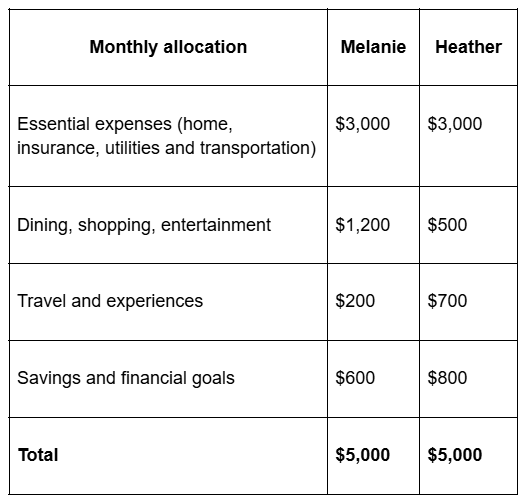
Melanie enjoys dining out and shopping. Heather prefers travel and building additional savings.
Neither spending plan is automatically right or wrong. The important question is whether those choices reflect their goals and whether they are financially sustainable. Only they can answer that question, but hopefully this example provides some clarity on how unique our own money story can be.
If someone looked at your spending over the last 30 days, would they be able to identify what matters most to you?
5 Benefits of Living Below Your Means for Retirement
I was blessed with guidance from my dad to think about my financial goals in my early twenties and refined them in my thirties when he suddenly passed away. His passing resonated with me because he became ill with cancer at 60 and died two years later–never having the chance to live the retirement lifestyle he dreamed about.
I got laser focused with my financial goal to retire early at age 58.
To achieve this goal, it meant I needed to set aside extra funds to support my lifestyle before the average retirement around age 65. This meant saving more than normal and living on less.
For me, living below my means wasn't about limiting my life. It was about creating the financial flexibility to live the life I wanted—on my own timeline.
I truly believe that living below your means can help you:
✔️ Increase your retirement savings.
✔️ Reduce reliance on debt.
✔️ Build flexibility for unexpected expenses.
✔️ Create more choices about when and how you retire.
✔️ Support a retirement lifestyle that aligns with your values.
If your retirement calculator suggests you're not financially ready, revisiting your monthly spending plan could be one of the most practical adjustments you make. I explore this topic in more detail, read about Your Retirement Calculator Says You're Not Ready. Now What?
Understanding what you spend today—and what you might need tomorrow—can help you create a more realistic retirement roadmap.
Free Monthly Spending Plan Spreadsheet and Video Tutorial
Ready to put your financial goals into action?
Knowing why a monthly spending plan matters is one thing. Knowing how to create one is another!
In my latest Money How-To with Coach Kathy video, I walk you through how to use a monthly spending plan spreadsheet to organize your income, plan your expenses, and make intentional decisions about your money.
Watch: How to Create a Monthly Spending Plan with Coach Kathy
Download: Your FREE Annual Spending Plan Tracker Excel Spreadsheet
You don't need a complicated budgeting system to get started. You need a spending plan that fits your lifestyle, supports your priorities, and gives you the flexibility to make adjustments along the way.
Start Living Below Your Means with One Small Change
When we are overwhelmed, especially with finances, it’s important to start small.
This week, take 20 minutes to review your spending. If you don’t use an existing process like an app or spreadsheet, export your bank statements and credit card charges to see where your money is going.
Identify one expense that no longer aligns with your priorities and one financial goal that deserves more attention.
Then make one intentional adjustment.
Remember, your spending plan doesn't have to be perfect. It just needs to help you make progress toward the life you want.
Living below your means isn't about having less. It's about making room for more of what matters.
Frequently Asked Questions About Monthly Spending Plans
Q. What is the difference between a budget and a monthly spending plan?
A. Both help you manage your money. A monthly spending plan emphasizes intentionally allocating income toward essential expenses, personal priorities, savings, and financial goals rather than focusing only on spending restrictions.
Q. How do I create a monthly spending plan?
A. Start by identifying your monthly income, listing essential expenses, choosing your spending priorities, including financial goals, and reviewing your plan each month. A simple spreadsheet can help you organize and adjust your numbers.
Q. Does living below your means mean giving up everything you enjoy?
A. Not at all! Living below your means means spending less than you earn while making intentional choices about what matters most. You can still enjoy travel, hobbies, dining out, and meaningful experiences when those expenses fit your financial plan.
Q. How often should I review my spending plan?
A. Review your spending plan at least monthly and whenever your income, expenses, or financial priorities change. A 15–20-minute monthly check-in can help you stay organized and make adjustments before small issues become bigger challenges.
If you're ready to turn your knowledge into a clear financial plan, coaching can help you take the next step. Schedule your FREE 45-minute retirement clarity call and start building your financial confidence today.
Your financial roadmap doesn't have to be perfect. It just needs to keep you moving forward.
And if you have enjoyed this article, follow me on social media @lordfinancialcoaching.