Open Enrollment Time: Are You Choosing the Cheapest Health Plan—or the Smartest One?
Why comparing premiums, deductibles, out-of-pocket costs, and HSA benefits could help you make a more confident financial decision.
It's open enrollment season again. You log into your employer's benefits portal, notice your health insurance premiums have increased, and wonder whether you should simply stick with last year's plan.
But what if the plan with the lowest monthly premium isn't actually your most affordable option? And what if a high-deductible health plan—one you might normally overlook—could offer financial advantages beyond covering your medical bills?
Before you click "Enroll," let's look at the bigger financial picture.
Why health insurance deserves a fresh look every year
I have been reading in the news a lot lately that rising employer healthcare costs means employees may face higher premiums or greater cost sharing during the 2027 open enrollment period.
I would encourage you to not automatically renew last year's coverage because it may mean you are overlooking better options.
The five numbers to compare before choosing a plan
When you are looking at benefit packages there are a variety of items that you should review before choosing the plan for your household. Here are five numbers I recommend you focus on:
1️⃣ Annual premiums: What will you pay just to maintain coverage? Total up the entire amount that will be coming out of checks, we often forget how significant this amount is because we do not look at the holistic value.
2️⃣ Deductible: How much must you pay before certain insurance benefits begin?
3️⃣ Copays and coinsurance: What will routine visits, specialists, and prescriptions cost? Remember copays often apply before your deductible is met.
4️⃣ Out-of-pocket maximum: What's your potential financial exposure for covered, in-network care? This is the worst-case scenario but often overlooked so be aware of what your maximum annual amount could be.
5️⃣ Employer Health Savings Account (HSA) contributions: Is your employer offering money toward future medical expenses? Some employers offer free cash to seed your HSA either at the first of the year or through payroll deposits.
Don't choose your health insurance based on what worked yesterday. Choose based on what your financial life needs tomorrow.
Why a high-deductible health plan with an HSA deserves consideration
I believe that in the long run a HSA deserves serious consideration.
Not every employer offers one, but if yours does really investigate that option you might be surprised at the advantages.
So what is a HSA? A Health Savings Account (HSA) is a tax-advantaged savings account often paired with a High-Deductible Health Plan (HDHP) where you pay for qualified medical expenses from your HSA.
A few key features that make them intriguing:
✔️ Triple-Tax Advantage: Contributions are pre-tax or tax-deductible, account growth (interest and investments) are tax-free, and withdrawals used for qualified medical costs are 100% tax-free.
✔️ HSA’s Roll Over Indefinitely: Unlike Flexible Spending Accounts (FSAs), unused HSA funds do not expire at the end of the year. They roll over year after year.
✔️ Portability: The HSA account belongs to you, not your employer. If you change jobs or retire, you keep the money. There is potential to build significant savings for healthcare costs in retirement if your funds stay and grow year over year.
✔️ Investment Options: Once your balance reaches a specific threshold set by your provider, you can invest the funds in stocks, bonds, or mutual funds to grow your money long-term (similar to other investments like retirement accounts).
Important balance: Not every high-deductible plan is HSA-eligible, and an HSA doesn't automatically make any plan the best choice, so do your research.
There are eligibility requirements to be aware of. To open and contribute to an HSA, you must meet these IRS rules:
Be enrolled in an HSA-eligible High-Deductible Health Plan (HDHP).
Have no other secondary health coverage (such as Medicare or a non-HDHP spouse plan) as that disqualifies you.
You cannot be claimed as a dependent on someone else's tax return
What could an HSA mean for your financial future?
I have chatted with many individuals about the pros and cons of HSAs. One of my favorite advantages is putting additional funds into my HSA (remember contributions are pre-tax or tax-deductible).
For calendar year 2027, the IRS HSA contribution limits are $4,500 for self-only coverage and $9,000 for family coverage. In addition, there is a catch-up contribution for those age 55 and older of $1,000.
These are total annual limits, including employer contributions, subject to eligibility and applicable prorating rules.
A real-world comparison—lower premiums versus lower deductibles
Here is a hypothetical example of three employer plans:
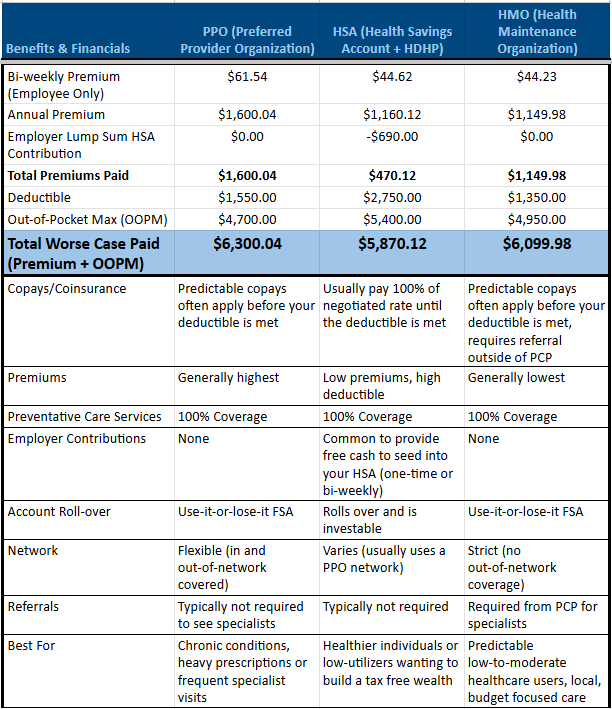
Illustrative figures only, not actual plan quotes. Net annual cost = premiums + medical cost sharing − employer HSA contribution. The HSA contribution remains the employee's asset rather than being a direct reduction in medical bills.
The HSA plan wins in this particular illustration, but a different pattern of healthcare usage could change the result.
So I want you to consider three scenarios: a relatively healthy year, a year with moderate medical expenses, and a year with significant healthcare needs. Perform your analysis on not just the financial ramifications but also the benefits changes for these plans.
In my experience HSA’s are beneficial for healthier individuals or low-utilizers wanting to build tax-free wealth but if you have chronic conditions, heavy prescription use or frequent specialists then staying with your HMO or PPO plans could make sense for you.
The smartest health insurance decision isn't always the plan with the lowest premium or the lowest deductible. It's the plan that best fits your healthcare needs, your budget, and your long-term financial goals.
Life transitions that should influence your benefits decision
If you experience life changes then consider revisiting your benefits.
Explore how health insurance choices can change when you may be approaching retirement, perhaps you changing careers, relocating, supporting family members, or managing new healthcare needs.
I would give special attention to early retirement and the years before Medicare eligibility. For example, readers should understand that enrolling in Medicare generally ends their eligibility to make new HSA contributions, although existing HSA funds remain available for eligible expenses.
Your open enrollment 2027 action plan
I recommend you check-off these five practical steps:
☑️ Download your employer's benefits comparison documents.
☑️ Review your healthcare spending from the past 12 months.
☑️ Estimate next year's premiums and medical expenses for each option.
☑️ Compare HSA eligibility, employer contributions, and tax advantages.
☑️ Choose the plan that best balances healthcare needs, cash flow, and long-term financial goals.
Commit to taking the time to assess these options as your health insurance decision isn't just about protecting your health. It's about protecting your financial future, too.
If you would like to run your own healthcare comparisons, download my free HSA Comparison tool.
Or if you need some specific guidance on achieving your retirement goals, schedule a FREE 45-minute Retirement Clarity Call, where we'll explore where you are today, what retirement scenarios could tell you, and the next steps toward the future you envision.
If you have enjoyed this article, follow me on social media @lordfinancialcoaching.