Before You Trust a Retirement Calculator, Check These 5 Assumptions
A retirement planning calculator helps estimate whether your savings, future income and expected spending may support your desired retirement lifestyle. But the results depend on the information you enter and the assumptions used for inflation, investment returns, life expectancy and other factors. Understanding those assumptions is an important part of using a retirement calculator effectively.
Have you ever gone online to use a retirement calculator where you entered your age, savings and desired retirement date?
Did the news come back that you are on track?
But what if the calculator assumed your investments would earn 10% every year?
Or that you'll spend significantly less in retirement?
Or that you'll only need your money until age 85?
Change a few assumptions and suddenly that reassuring green checkmark may tell a very different story.
A retirement calculator isn't a crystal ball. It's a scenario-building tool—and the quality of the scenario depends on the assumptions behind it.
How Does a Retirement Planning Calculator Work?
Retirement calculators are data-driven planning tools that typically combine information such as: your current age, existing retirement balances, your proposed retirement age, expected retirement spending and income sources.
Depending on the calculator, additional assumptions may include: investment growth, inflation, life expectancy and sometimes Social Security or future spending.
Never accept the retirement calculator defaults without understanding what they mean.
5 Retirement Calculator Assumptions You Should Check
1️⃣ Inflation: How Will Inflation Affect Your Retirement Spending? For example, at an assumed 3% annual inflation rate, a lifestyle costing $70,000 today would cost approximately $94,000 in 10 years. That's why it's important to understand whether your calculator uses today's dollars or future inflated dollars. So be aware of the calculator's inflation assumption and ask yourself if inflation is included, does the calculator inflate my future spending and can I change the assumption?
2️⃣ Investment Returns: What Rate of Return Should You Assume?. If a calculator defaults to a particular rate of return, don't simply assume you'll receive it. As a recent retiree, I've also learned about retirement spending guardrails—an approach that involves adjusting withdrawals or spending when investment performance changes. It reminded me that retirement planning isn't just about assuming one investment return. It's also about understanding how I might respond when markets perform better or worse than expected. Rather than relying on a single rate of return, consider testing conservative, moderate and optimistic scenarios. Investment returns rarely arrive in a smooth, predictable pattern. Even two retirement scenarios with similar average returns can produce different outcomes depending on when market declines occur. So ask yourself: “What happens to my retirement plan if investment returns are lower than expected?”
3️⃣ Life Expectancy: How Long Should Your Retirement Savings Last?. A retirement calculator might ask how long you expect to live or automatically choose an age. But retirement planning isn't about predicting the exact date someone will die. It's about asking: “What happens if I live longer than expected?” Although my parents passed away in their 60s, I chose not to assume my own life expectancy would be the same. Instead I encourage you to test a longer-life scenario rather than relying solely on an average.
4️⃣ Social Security: What Benefit Amount and Claiming Age Should You Use? The Social Security Administration will provide you a report with specifics on what you can expect as potential income based on when you retire. Visit the ssa.gov website to review your personalized benefit estimates and confirm the calculators assumed claiming age. An estimate based on a particular future earnings pattern may need adjustment if someone retires earlier than expected.
5️⃣ Retirement Spending: How Much Money Will You Actually Need? This might surprise you, but do not simply assume you will spend 70% or 80% of your pre-retirement income. You really need to assess this number so there are no surprises when you step away. Instead explore what do you actually want retirement to look like and then confirm those expenses (for example travel, housing, healthcare, hobbies, dining out, family adventures, giving, transportation). Some expenses may disappear but you could be shocked as others may increase. I have heard from many retirees that they are shocked how much their food budget went up because they just don’t want to stay home and cook, so be realistic and really consider lifestyle changes and talk to your friends and family about their own surprises when they go into retirement. Lessons learned by others can be pivotal in keeping your plan honest.
Your retirement vision gives the calculator something meaningful to calculate.
How to Use a Retirement Calculator to Compare Scenarios
As a planner and spreadsheet gal, this is where I really had some fun.
Instead of asking myself “Can I retire?”.
I would encourage you to instead ask: “What happens if...?” And this is where retirement planners and retirement calculators can provide a variety of results.
For example run multiple scenarios, what if you retire at 60, or 65 or even 70?
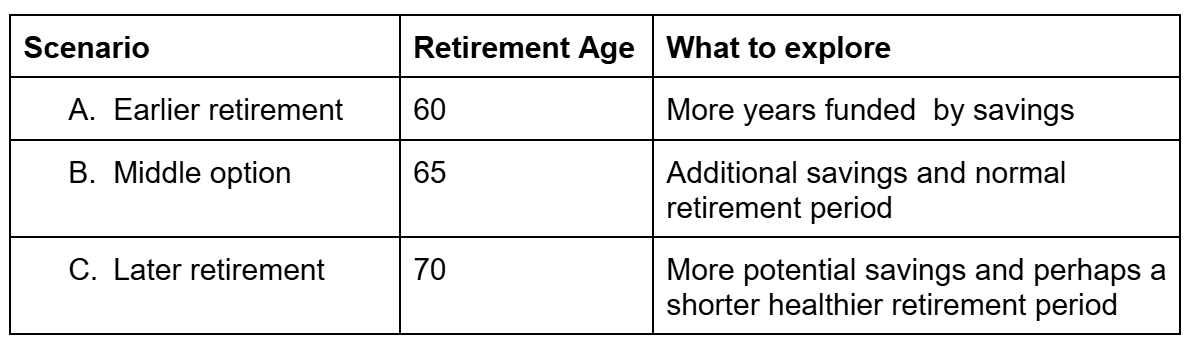
Try running these three scenarios while keeping your other assumptions consistent. Compare the results, then change one additional variable—such as spending, housing, location or investment returns—to see how sensitive your plan may be.
The real value of a retirement calculator isn't getting one answer. It's seeing how different decisions may change the answer.
What Can You Change if Your Retirement Calculator Shows a Gap?
After running scenarios it is important to evaluate the results.
Perhaps you got great news and can retire earlier than planned.
Or maybe the results were not as expected and you are not in such a good spot as you hoped.
Please know that you aren’t powerless if the first result is not what you hoped.
So revisit your potential retirement levers. These could include:
Your retirement date • Annual spending • Savings rate • Social Security timing • Part-time income • Housing • Investment strategy
Rework the plan and continue to monitor and reassess often.
A calculator that shows a gap isn't necessarily giving you bad news. It's giving you information you can use to make decisions.
When Should You Update Your Retirement Plan?
A retirement calculation shouldn't be “one and done.”
Consider rerunning your scenarios if you have experienced life changes.
Did you have a career change or job loss? Perhaps a significant income change? Have your family circumstances changed with a divorce? Did you have to relocate or are now experiencing an empty nest? Have you undergone a major health issue or even an insurance change? Has there been a shift in retirement goals?
Whether you're five years from retirement or twenty years away, a major life transition is a natural time to revisit your retirement planning assumptions and financial roadmap. If you would like to revisit the seven foundational steps of your financial roadmap.
Retirement Calculator Checklist: 5 Questions to Ask
There are a variety of retirement calculators out there either online or in spreadsheet form. So before using any calculators and trusting the results, I recommend this quick five-question checklist to ask yourself:
✓ What inflation rate is being used and am I comfortable with that number?
✓ What investment return is assumed and is this realistic to my risk tolerance?
✓ How long does my retirement plan need to last, and have I considered the possibility of living longer than expected?
✓ What Social Security income and claiming age are included?
✓ Does the spending assumption actually reflect the retirement I want?
A retirement calculator shouldn't tell you whether you “can” or “can't” retire. It’s not a crystal ball.
But it should help you explore possibilities, identify gaps and understand which decisions could move you closer to the retirement you envision.
Don't just run the calculator. Run the scenarios.
If you would like to see how I ran an actual retirement planning calculator scenario, check out my Money How-To with Coach Kathy video demonstrating using a retirement calculator.
Or if you need some specific guidance on achieving your retirement goals, schedule a FREE 45-minute Retirement Clarity Call, where we'll explore where you are today, what retirement scenarios could tell you, and the next steps toward the future you envision.
If you have enjoyed this article, follow me on social media @lordfinancialcoaching.