The 7-Step Financial Roadmap to Build the Life You Want
Financial planning doesn't have to be complicated. Whether you're paying off debt, building an emergency fund, or preparing for retirement, following a step-by-step financial plan can help you make confident decisions and build long-term wealth.
Imagine getting in your car and driving across the country without using GPS or looking at a map.
You would probably make wrong turns, waste time getting lost and for sure spend more money on gas than necessary.
Personal financial planning works exactly the same way.
Without a roadmap, it's easy to drift from paycheck to paycheck without making meaningful progress toward the future you want.
The good news? You don't have to figure everything out at once.
Instead, focus on these seven financial planning steps.
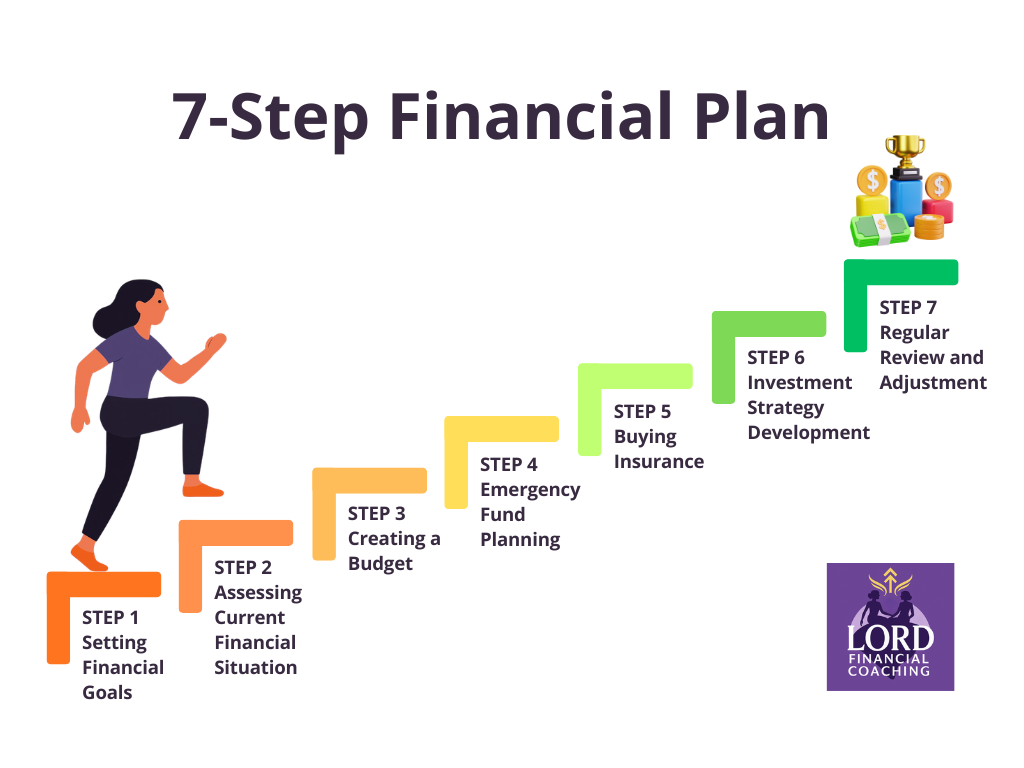
Lord Financial Coaching™ 7-Step Financial Plan
Step 1: Define Your Financial Goals
Without goals… every financial decision you make seems random.
Each of us have to decide what we think is important, but some examples of financial goals are:
Having an emergency fund
Creating a plan to payoff your debt
Save for a future vacation
Buying a home
Aspire towards early retirement
Defining goals is very personal and should take time to define because often to achieve success it might require life changes, new habits or even sacrifices.
If you are not sure which money goal to start with, here are some questions to consider:
What does success look like to you?
What do you want money to do for you?
What are your financial values?
Step 2: Assess Where You Are Today
It is very hard to plan for the future if you don’t have a baseline.
So your next step is to know your starting point.
Take a weekend or a few hours on a quiet evening and perform a review.
Before creating a financial plan, review your monthly income, fixed and variable expenses, debt balances, savings, investments, retirement accounts, and calculate your net worth. If you have never calculated your net worth check out my blog.
You can't build a roadmap without knowing your current location.
Step 3: Create a Spending Plan
Creating a plan can seem overwhelming, but if you do not define how you are going to spend your money how will you know if you have enough? [Source: NerdWallet]
I like "Spending Plan" better than "Budget."
It is important that you tell every dollar where to go.
Each household should have a budget plan or spending plan; no matter what you call it.
You can start high-level with easy categories, think housing, food, insurance, lifestyle and utilities.
Then once you get more familiar and comfortable, in a few months you can start going deeper and create separate subcategories.
I always encourage my clients to start simple, because if you have not been managing a budget in a while (or never) it can feel so strange. So start small.
Once you define your spending plan you may find there is not enough money to go around.
If you're in debt, this can be a hard pill to swallow. But remember, it’s not impossible!
You will need to prioritize, and that may mean some credit cards or bills don’t get paid.
Start with your needs: food, utilities, shelter, and transportation.
Then consider your money goals, can you prioritize those next?
If you do have some money left over, how can you find some small enjoyment? Perhaps you go on a mini adventure, or take someone out for a special meal.
Step 4: Build an Emergency Fund for Financial Security
Life happens. Cars break. Jobs change. Medical bills appear.
An emergency fund protects your long-term plan from short-term surprises.
So many individuals I chat with would love to have 6 months of savings just in case.
But that number may feel impossible to achieve when you're in debt or if money is tight.
So I encourage a starter emergency fund, Dave Ramsey recommends $1,000).
Once you get out of debt you should consider boosting your emergency fund to have a 3 to 6 month balance.
Step 5: Protect What You've Built
Insurance isn't sexy nor is it exciting.
But it's one of the smartest financial decisions you'll make.
Insurance is an essential part of financial planning because it protects the assets and wealth you've worked so hard to build.
I recommend the following must-haves:
Health
Auto
Home/renters
Term Life
Disability
Umbrella (if your net worth is above $500k)
Long-term care (for 60+ individuals)
You should have all of the above, and I recommend you don’t wait till your out of debt to ensure you have the proper coverage.
Step 6: Build Your Investment Strategy for Retirement
This isn't about picking stocks. It's about creating a plan.
This article will not go into a lot of details around investments, risk factors or ROI. Instead we will keep it high-level.
Investing is a personal decision as only you can define what risks you're willing to take, how much you should save and where.
But some investment options I recommend are:
401(k)
IRA
Roth
Brokerage
Health Savings Account (HSA)
Whether your goal is early retirement, traditional retirement, or financial independence, consistently investing over time allows compound growth to work in your favor.
If this means you start small, then start small. Do not be intimidated when advisors mention you need to save 10%, 15%, 20% of your income.
Start with 3% and then keep increasing year after year.
And remember, having a diverse investment portfolio can ensure a balanced lifestyle in your retirement.
Step 7: Review and Adjust Regularly
Life changes. Income changes. Goals change. Markets change.
Your financial plan should evolve too.
I recommend that you perform monthly money check-ins, which include reviewing your spending plan before the month begins.
This allows you to continue to be flexible on your estimates and ensure the plan is mostly accurate.
Next I encourage a quarterly review to assess how your spending went after the last few months. This allows you time to adjust any of those seasonal or ad-hoc expenses that come up too.
Finally you should revisit your goals annually. Taking a look yearly allows you reflection time to either continue with the same financial goals, or perhaps conduct a goal reset.
Common Financial Planning Mistakes
This is where we will address the potential road blocks you may hit during this process.
I also want to address what can commonly go wrong.
Below are some common mistakes I have heard about. It is typical that many people will struggle–you are not alone.
Often, individuals will:
Putting everyone else's financial needs ahead of your own. If this is you, remember what the stewardess says “put your mask on first”. This is your moment to address that you and your financial needs are just as important as your family–give it the attention you deserve!
Wait for the “perfect time” to start. Financial planning does not have to be perfect–it just has to begin.
Believes a budget is too restrictive. Without a spending plan for your money, it is easy to lose sight of where it is going.
Neglecting an emergency fund. Unplanned expenses can quickly derail your progress if you are unprepared.
Believing you need a large income before you can invest. This is an old wives tale, you can start small. The importance is to start so that you can leverage the returns on long term portfolio growth.
Focusing only on investing. Building wealth means protecting it with the right insurance and a solid financial foundation.
Not reviewing their plan. Financial planning is not the “set it and forget it” experience. Life happens, and you need to revisit your successes and opportunities so your financial plan should evolve with it.
Try to do everything at once. Unless you have a ton of free time, your financial planning will need to be tackled in stages. Trying to accomplish it all at once will either paralyze you from procrastination or give you anxiety because you're rushing. This is your long-term future, take time for each step to ensure clarity and understanding.
The good news? Every one of these mistakes can be corrected. The important thing is to recognize where you are today and take the next step forward.
If you are struggling to let go of past money mistakes, I recommend reading: How to Let Go of Financial Regrets and Move Forward.
Financial planning checklist
To summarize, below is your personal checklist to create your own financial plan:
✔️ Define your financial goals
✔️ Assess where you stand financially today
✔️ Create a spending plan
✔️ Assemble your emergency fund
✔️ Perform an insurance coverage check
✔️ Build your investment strategy
✔️ Analyze your plan
FREE Download: Lord Financial Coaching™ 7-Step Financial Planning Checklist
Conclusion & Next Steps
A roadmap only works if you actually follow it.
Financial planning isn't about completing all seven steps in one weekend. It's about making consistent progress over time. Every goal you define, every dollar you save, and every review you complete moves you closer to financial confidence and the retirement lifestyle you envision.
Each small step you take today moves you closer to the future you're working so hard to build.
If you are looking to enhance your financial literacy, here are my recommendations for the 5 Best Money Books to Improve Your Financial Confidence.
If you're unsure which step should come next in your financial journey, I'd love to help. During a FREE 45-minute retirement clarity call, we'll identify where you are today and build a roadmap toward the future you want.
If you have enjoyed this article, follow me on social media @lordfinancialcoaching.